
With four inputs and seven outputs, writing logic equations for the seven-segment decoder is a formidable task (seven four-variable Karnaugh maps!). However, just to keep your skills sharp, pick a couple of outputs and derive reduced logic equations in minimum sum-of-products form.
Section 4.3 Seven-segment display decoder
Not all decoders are of the one-hot variety. Here is an example of a more complex decoder.
A popular way to display numerals uses seven LED-illuminated segments, arranged as shown in Figure 16.1.1. The segments are labeled \(a\) through \(g\text{.}\) The display can easily show the decimal numerals 0 through 9, and with a little imagination, the additional hexadecimal characters A through F (as A, b, c, d, E, F). A display may also include a decimal point as an eighth "segment".
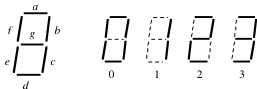
The signals to drive the segments are produced by a special 4-to-7 decoder that follows the truth table shown in Figure 4.3.2.
| \(\mathbf{x}\) | \((x_3 \ x_2 \ x_1 \ x_0)\) | \((a \ b \ c \ d \ e \ f \ g)\) | \(\mathbf{x}\) | \((x_3 \ x_2 \ x_1 \ x_0)\) | \((a \ b \ c \ d \ e \ f \ g)\) |
| \(0\) | \(0 \ 0 \ 0 \ 0\) | \(1 \ 1 \ 1 \ 1 \ 1 \ 1 \ 0\) | \(8\) | \(1 \ 0 \ 0 \ 0\) | \(1 \ 1 \ 1 \ 1 \ 1 \ 1 \ 1\) |
| \(1\) | \(0 \ 0 \ 0 \ 1\) | \(0 \ 1 \ 1 \ 0 \ 0 \ 0 \ 0\) | \(9\) | \(1 \ 0 \ 0 \ 1\) | \(1 \ 1 \ 1 \ 0 \ 0 \ 1 \ 1\) |
| \(2\) | \(0 \ 0 \ 1 \ 0\) | \(1 \ 1 \ 0 \ 1 \ 1 \ 0 \ 1\) | \(10 (A)\) | \(1 \ 0 \ 1 \ 0\) | \(1 \ 1 \ 1 \ 0 \ 1 \ 1 \ 1\) |
| \(3\) | \(0 \ 0 \ 1 \ 1\) | \(1 \ 1 \ 1 \ 1 \ 0 \ 0 \ 1\) | \(11 (b)\) | \(1 \ 0 \ 1 \ 1\) | \(0 \ 0 \ 1 \ 1 \ 1 \ 1 \ 1\) |
| \(4\) | \(0 \ 1 \ 0 \ 0\) | \(0 \ 1 \ 1 \ 0 \ 0 \ 1 \ 1\) | \(12 (C)\) | \(1 \ 1 \ 0 \ 0\) | \(1 \ 0 \ 0 \ 1 \ 1 \ 1 \ 0\) |
| \(5\) | \(0 \ 1 \ 0 \ 1\) | \(1 \ 0 \ 1 \ 1 \ 0 \ 1 \ 1\) | \(13 (d)\) | \(1 \ 1 \ 0 \ 1\) | \(0 \ 1 \ 1 \ 1 \ 1 \ 0 \ 1\) |
| \(6\) | \(0 \ 1 \ 1 \ 0\) | \(0 \ 0 \ 1 \ 1 \ 1 \ 1 \ 1\) | \(14 (E)\) | \(1 \ 1 \ 1 \ 0\) | \(1 \ 0 \ 0 \ 1 \ 1 \ 1 \ 1\) |
| \(7\) | \(0 \ 1 \ 1 \ 1\) | \(1 \ 1 \ 1 \ 0 \ 0 \ 0 \ 0\) | \(15 (F)\) | \(1 \ 1 \ 1 \ 1\) | \(1 \ 0 \ 0 \ 0 \ 1 \ 1 \ 1\) |
Read more about seven-segment decoders in Chapter 16.
Checkpoint 4.3.3.
Checkpoint 4.3.4.
In the special case of a binary coded decimal (BCD) to seven-segment decoder, rows 10-15 of the truth table are assumed never to be used, and we don’t care what the outputs are in these cases. On the Karnaugh map, the cells corresponding to these rows can be marked as ’1’ if that enables you to create larger groups. Try this in your solution to the previous exercise and see if it results in simpler logic.

