Electric current is the flow of electric charge. While many electrically charged particles exist in nature (e.g., electrons, protons, alpha particles, chemical ions), the one of fundamental importance in electronics is the electron, which has a charge of approximately \(-1.602 \times 10^{-19}\) coulombs. Electric current is measured in amperes, or amps (A). Officially, the ampere is a fundamental unit and the coulomb is derived from it, defined to be the amount of charge flowing in a one ampere current in one second. Thus, a 1 amp current is a flow of about \(6.24 \times 10^{18}\) electrons per second. Until the discovery of the electron in the twentieth century, it was believed that electric current consisted of positive charges, and engineers continue to follow a positive current convention, imagining positive charges flowing in the direction opposite the actual electron flow.
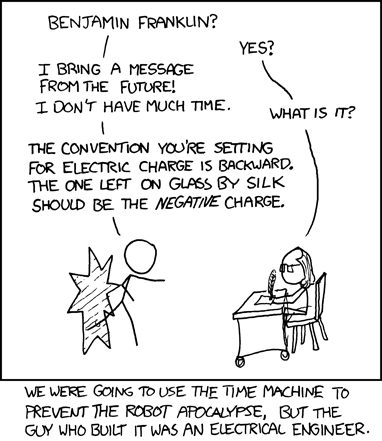
XKCD cartoon. Man from the future warns Ben Franklin that electric charge is negative.
In digital electronics we typically work with currents smaller than an ampere, and use the more convenient units milliampere (mA, \(10^{-3}\)A) or microampere (\(\mu\)A, \(10^{-6}\)A).
Voltage, resistance, Ohm’s law.
An electric current will flow wherever charges can be made to move: in vacuum (e.g., as part of the solar wind, or inside a vacuum tube), in liquids (salt water), gases (a lightning strike in the air, or the current producing the glow in a fluorescent lamp), in metals (wires), and in the special materials called semiconductors, used to fabricate the transistors at the heart of modern electronics. These media have a natural resistance to the flow of current, which must be overcome in some way. Resistance is measured in units of ohms , abbreviated \(\Omega\text{.}\) Larger units, commonly used, are the kilohm (K\(\Omega\) or K, \(10^3\) ohms) and the megohm (M\(\Omega\) or M, \(10^6\) ohms).
The necessary impetus for current flow is called voltage, and is measured in units of volts (V). In electronics, voltage is typically supplied by a battery or a power converter plugged into a wall outlet.
The relationship between current, voltage, and resistance is given by Ohm’s law, written
\begin{gather*}
V = IR,
\end{gather*}
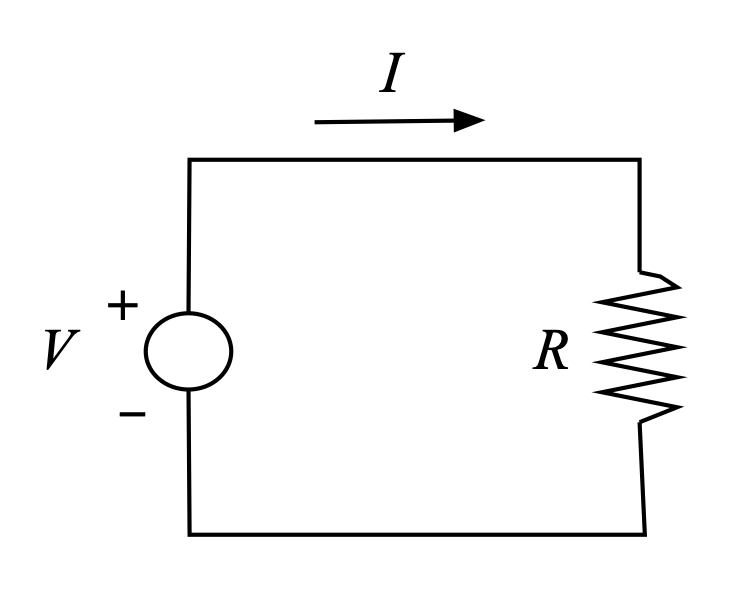
where \(V\) is voltage (V), \(I\) is current (A), and \(R\) is resistance (\(\Omega\)). Ohm’s law is illustrated by the circuit below.
Figure2.1.1.Illustrating Ohm’s law. A voltage source causes current to flow through a resistance.
The two terminals of the voltage source are labeled positive (+) and negative (-). Electrons flow out of the negative terminal, around the circuit, and back to the positive terminal; however, according to the positive current convention, we write the current as an arrow pointing the opposite direction, from the positive terminal toward the negative. The zigzag line in the circuit is the symbol for a resistance, either naturally occurring (e.g., the resistance of the wire) or deliberately introduced via a discrete component called a resistor.
Ohm’s law says, for example, that a 5V source is needed to produce a 5mA current in a 1000 \(\Omega\) (1K) resistor.
Checkpoint2.1.2.
What current flows in a circuit with a 3.3V source and 100 \(\Omega\) resistor?
Answer.
Rewrite Ohm’s law to solve for current, then substitute the voltage and resistance values: \(I = V/R = 3.3\text{V} / 100\Omega = 33\text{mA}\)
Power consumption.
The current that flows in a circuit carries electrical energy, which is converted within the circuit either to useful output (e.g., the light emitted by a light emitting diode (LED)), or to heat, which is not useful unless you’re building an oven. Many circuits are battery powered, and we want to minimize the energy consumption of the circuit to operate as long as possible before recharging or replacing the battery. Even if a circuit is powered by a external supply, the energy consumed by the circuit has consequences for your electric bill and for the environment. Again, minimizing energy consumption is important.
The rate of energy consumption is called power, and has units of watts (which happens to be volts \(\times\) amps). We can calculate the power consumption of the circuit by multiplying the supply voltage by the current flowing into the circuit:
\begin{gather*}
P = VI
\end{gather*}
Using this expression with Ohm’s law, we can also calculate how much electrical energy from the supply is converted to heat by a resistor:
\begin{gather*}
P = I^2R = V^2/R
\end{gather*}
where \(V\)is the voltage drop measured across the resistor, and \(I\) is the current flowing through the resistor. This is called Ohmic heating, and is not a good thing if you are trying to minimize energy consumption.
Checkpoint2.1.3.
In a circuit with a 3.3V source and 100 \(\Omega\) resistor, how much power is dissipated by the resistor?
Answer.
Using \(P = V^2 / R\) and substituting values, \(P = 3.3^2 / 100 \approx 0.11\text{W} = 110\text{mW}\)
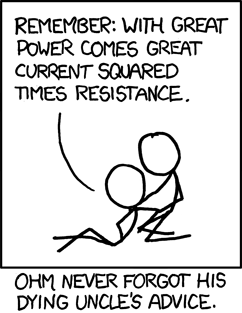
XKCD cartoon. Ohm’s dying uncle says that with great power comes great current squared times resistance.